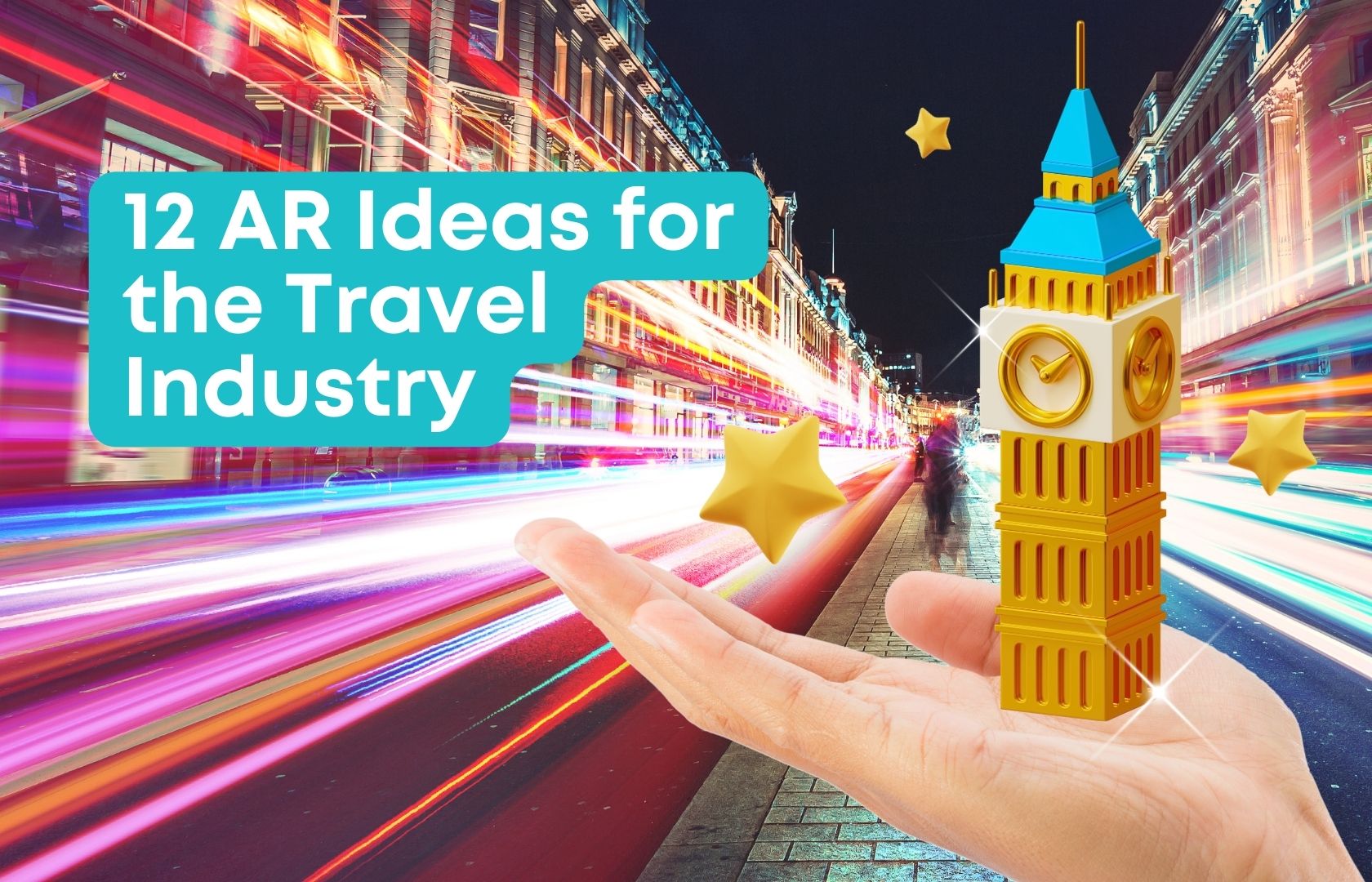

A new Forbes column by Anna Belova, Founder of DEVAR, has just been published on why augmented reality is steadily becoming part of the new infrastructure of travel. In the piece, Anna explains how AR is changing traveler expectations, turning physical space into a service layer, and why the technology is now moving beyond experiments into real-world adoption.
You can read the article on Forbes here. Below, we are also republishing the full text on the MyWebAR blog so you can easily save it and share it with your team.
Tourism has always been an industry of experiences, but today it is no longer enough for a traveler to simply see a place. What matters is understanding the context and living the story. The world is becoming multilayered, so the role of immersive technologies is growing, especially augmented reality (AR).
AR adds a digital layer and new meaning to physical space. As international tourism rebounds to levels close to pre-pandemic, with nearly 1.4 billion trips in 2024, competition for attention and for the quality of the experience has intensified. Audiences expect personalization, instant access to information and interactivity. In this context, AR has the potential to become part of the infrastructure of modern travel.
Space As A Digital Layer
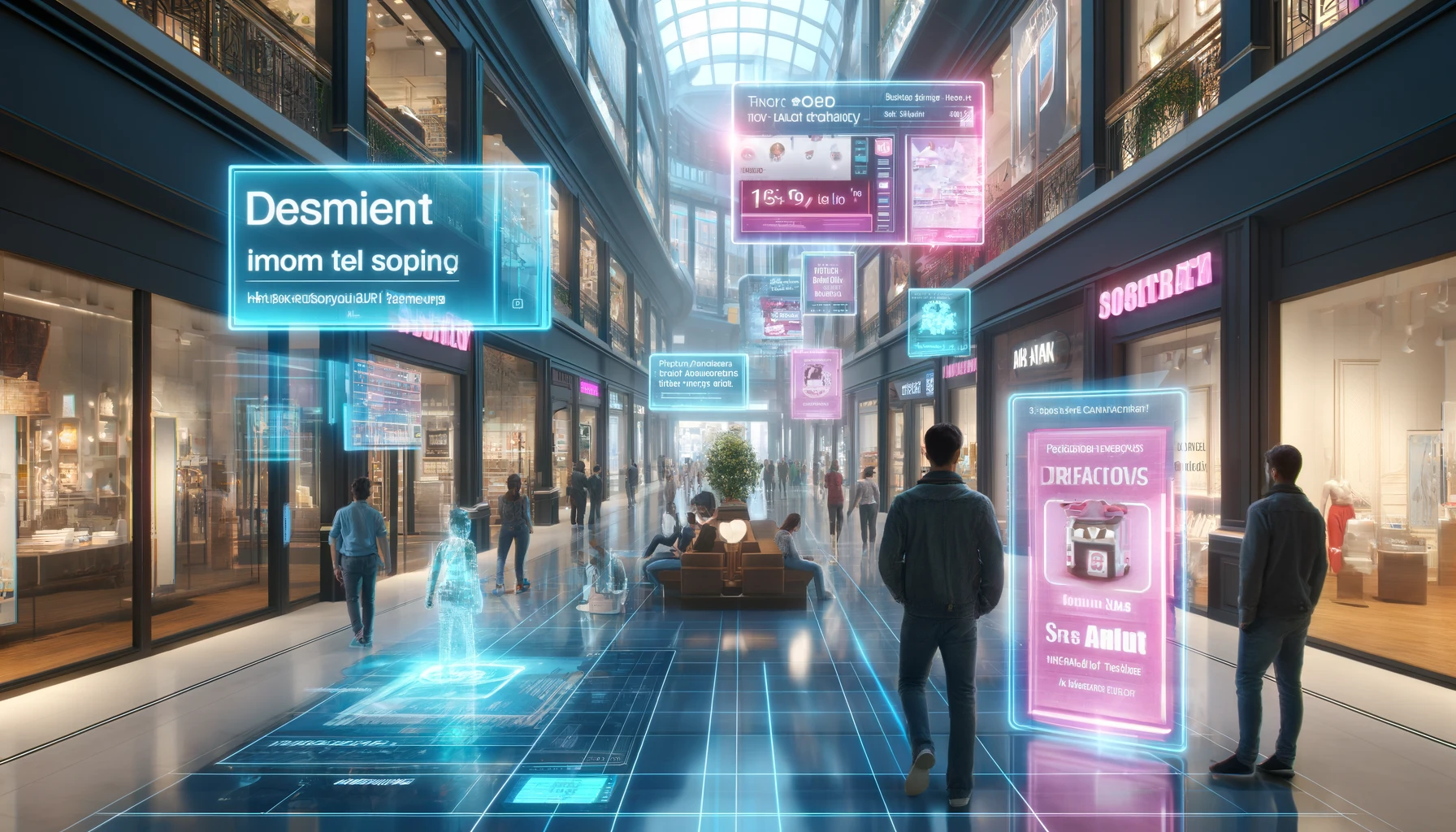
The era of installing separate apps for each cultural site is over. WebAR, which launches AR content directly in the browser on any smartphone, has opened a new format of interaction. Point a camera at a QR code and an additional layer of information appears.
The perception of space is changing too. If a building facade does not tell its story, if a map remains static, if a souvenir does not come to life, it may feel like missed potential to digital-savvy travelers. A generation raised in a digital environment perceives the world as interactive. Space has to respond. Tourism entrepreneurs should take note of these trends and look more broadly at what is possible.
History As Part Of The Service
One of the most durable AR use cases in tourism is tied to history. People want to see not only what has been preserved, but also what has disappeared. What did this street look like a hundred years ago? AR makes it possible not only to reconstruct the past, but to make it part of everyday experience. Ruins can be rebuilt in 3D. Old neighborhoods can come alive.
According to Research and Markets, the global augmented reality market could exceed $644 billion by 2032. A significant portion of this growth could come from education, retail and tourism. These industries all have one thing in common: They need context.
For cities, AR becomes a tool of cultural infrastructure. For museums, it’s a way to move beyond their walls. For tourism companies, it’s an opportunity to add value without increasing the physical load on the space.
The Global Base Already In Place
A key question that held back AR adoption in tourism for a long time was whether users had enough capable devices. Today, that question is settled.
According to the latest data, around 5.8 billion people worldwide use smartphones, and the total number of smartphones exceeds 7.5 billion devices. That statistic implies about 70% of the world’s population owns a smartphone. In the United States, that figure rises to 82%.
In practice, the infrastructure for browser-based AR already exists in a tourist’s pocket.
What Slowed Development
For a long time, the industry faced a clear barrier. Creating 3D content required studios, designers and budget. Supporting mobile apps meant a dedicated team. Many projects remained pilots and did not scale.
Today the situation has changed. First, WebAR has become a universal publishing channel. Second, generative AI has sharply reduced the cost of content production.
AI makes it possible to create 3D objects from text descriptions, generate animation and adapt materials into different languages. What used to take weeks can now be done in far less time. For tourism, where seasonality and speed to launch matter, this is especially valuable.
Marketing teams at hotels, museums and city administrations can test ideas on their own. Interactive routes, postcards that come to life and navigation in resorts or on cruise ships can become part of regular work, not a one-off experiment.
The Next Stage: Wearable Devices
At the same time, a new technology cycle is forming. Smart glasses are becoming lighter and more capable. Right now, breakthroughs in energy-efficient processors, cloud computing and computer vision are making AR glasses a technologically mature product, and major corporations are already speaking confidently about them becoming part of everyday life by 2030. Content created for smartphones today can run on glasses tomorrow with minimal changes.
For businesses, this may have far-reaching consequences. The concept of a phygital experience will likely become the standard. The question is how quickly we can adapt to the new reality it is already creating today.
The Economy Of Measurable Experiences
AR in tourism is about measurable scenarios. AR makes it possible to track engagement, time spent and the popularity of routes. You can see which reconstructions people watch to the end, where a tourist changes course and which offers lead to ticket purchases. You can see which immersive scenes in AR catalogs lead to bookings for tours, cruises and more. A city can get data on tourist behavior at specific points. These analytics can form an understanding of how a person makes decisions in real space.
Where AR Has Limits In Travel
While AR is gaining momentum, it also has real constraints worth addressing directly. AR is not a fit for every travel moment, and the biggest limitation is friction. If connectivity is weak, lighting is harsh or the device is older, the experience can feel slow or unreliable. Location and tracking are not perfect either, especially indoors or in dense urban areas where GPS is noisy.
There is also a safety factor. In busy streets, transport hubs or outdoor terrain, you do not want to encourage people to walk while staring at a screen. In those contexts, AR should be optional and lightweight, or it should not be used at all.
Another limitation is operational, not technical. AR content is a living layer, which means it needs maintenance: accuracy, translations, updates after renovations, changing routes, new opening hours, seasonal offers. If the content is not kept current, trust drops quickly.
Finally, tourism is global, so privacy and compliance matter. If an AR experience collects any data, companies need to be transparent and conservative, especially when the audience includes families and school groups.
Conclusion
Tourism is one of the most natural fields for augmented reality. It has always been full of stories, emotions and discovery. AR amplifies them, turning space into an interactive interface.
Today we are at a moment when the technology has become accessible, and content creation tools have been democratized thanks to AI. Wearable devices can create the next horizon. AR in smartphone browsers can provide scalability.
The best AR in travel behaves like a service. It reduces confusion, adds context or helps someone decide. The future of tourism is likely a virtual expansion of reality, providing travelers with an additional layer of meaning over the physical world.